
Recount
Using AI-assisted development to take a digital health product from concept to launch
Recount is a digital platform designed to help people share their life story with a new therapist without having to verbally recount difficult or traumatic experiences again and again.
The idea began with a clear human problem: for many people, especially those who have experienced trauma, beginning with a new therapist can be emotionally exhausting. The process of bringing a clinician “up to speed” often requires revisiting painful events in detail. Recount was created to reduce that burden by giving individuals a way to map their life events once, at their own pace, and securely share that context with a therapist when they choose.
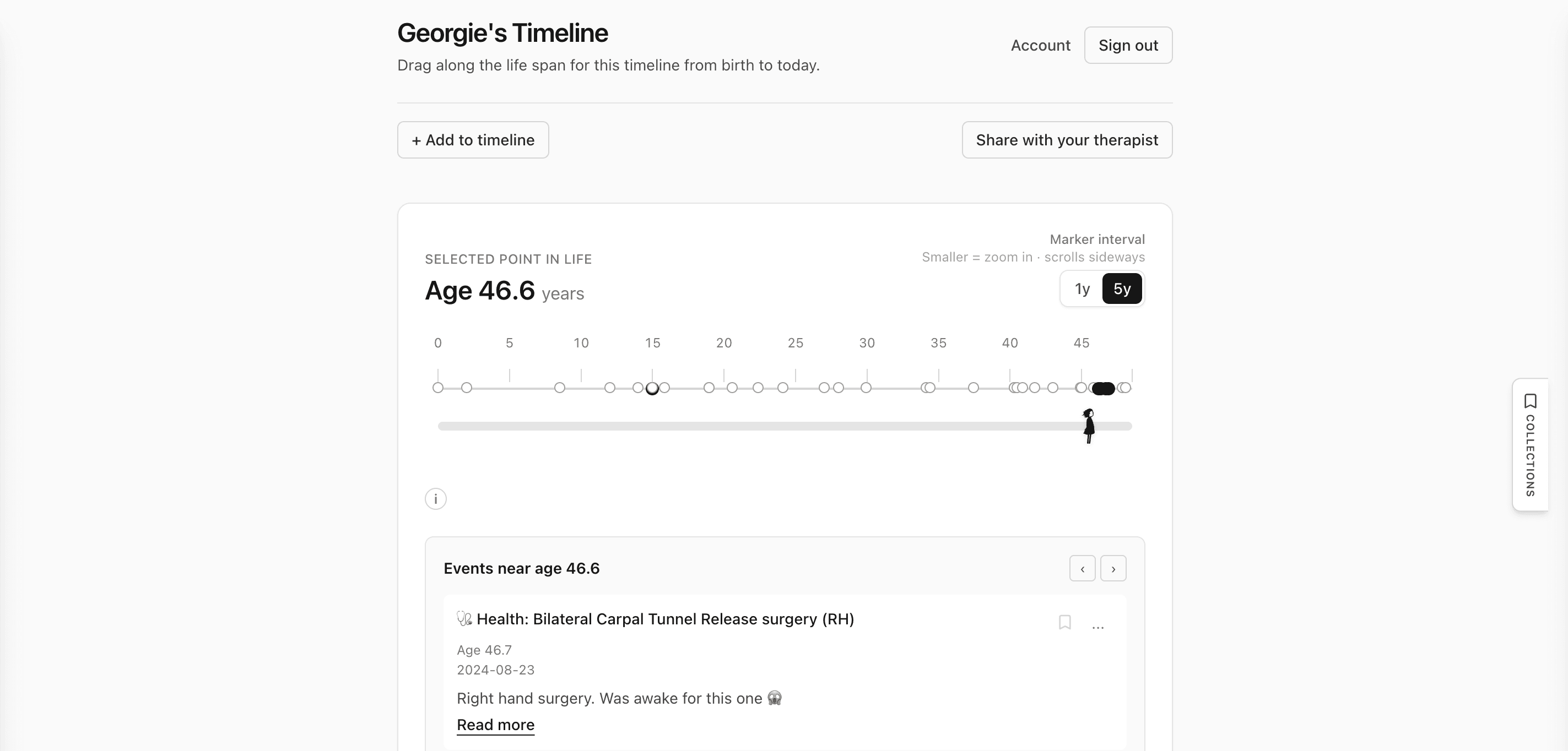
I developed Recount as a full-stack digital product using Next.js, Supabase, GitHub, Vercel and Cursor. The project demonstrates my ability to combine product strategy, systems thinking and AI-assisted development to move from concept to deployed software.
Importantly, AI did not define the product concept, user groups or user flows. Those foundations came from my own product thinking: identifying the problem, understanding the needs of different users, mapping the journey, defining the system logic and deciding how the platform needed to behave. Cursor was used as a development accelerator, not a replacement for the strategic and structural thinking required to design the product.
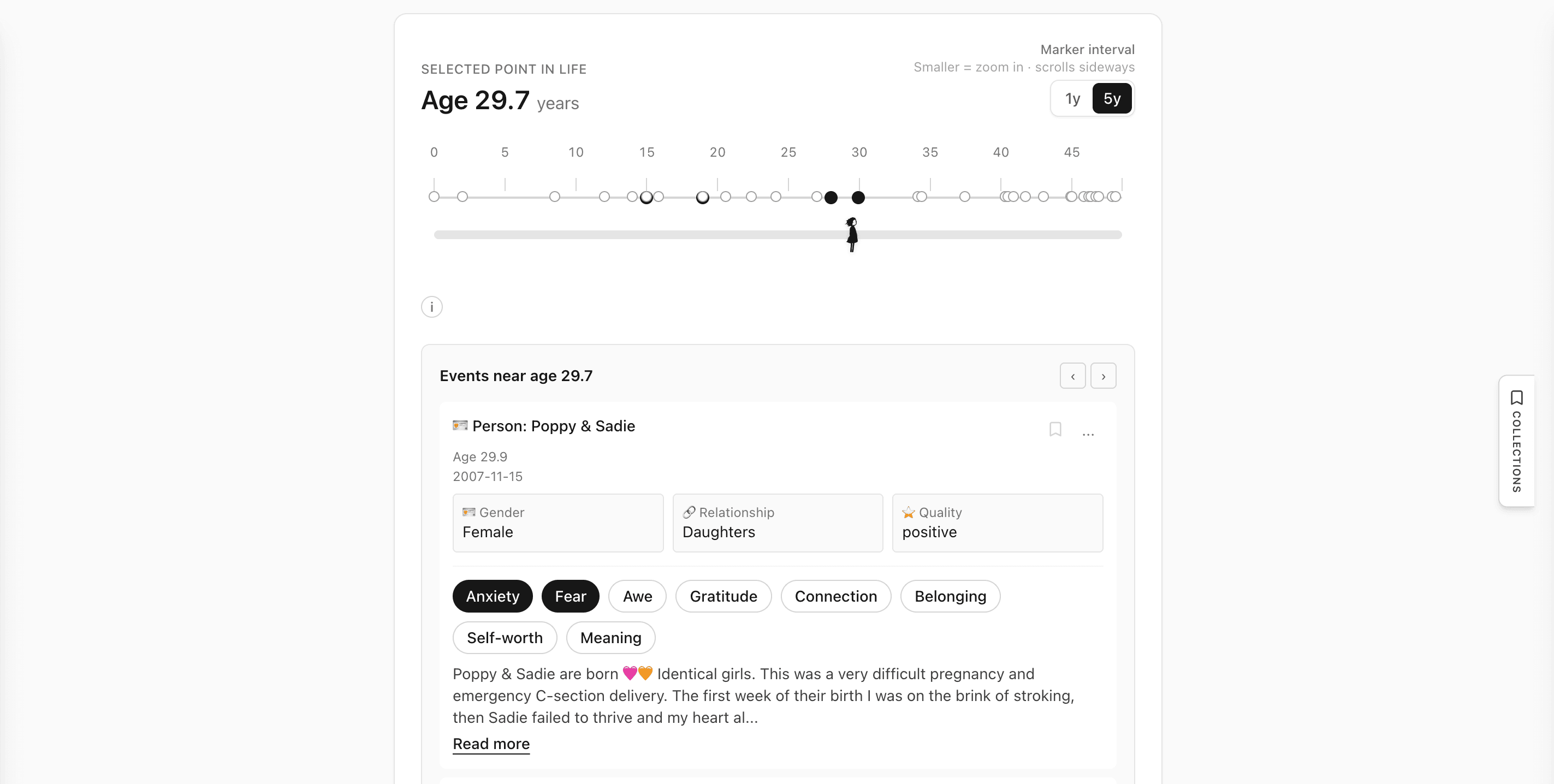
Since deployment, Recount has been tested with multiple Author and Therapist user groups. Feedback from both individual users and psychologists has been overwhelmingly positive, particularly around the value of helping clients share difficult personal histories in a more controlled, considered and less overwhelming way. This feedback has also shaped ongoing iteration, with a particular focus on ensuring the product can fit naturally into existing therapeutic workflows rather than creating additional administrative burden for clinicians.
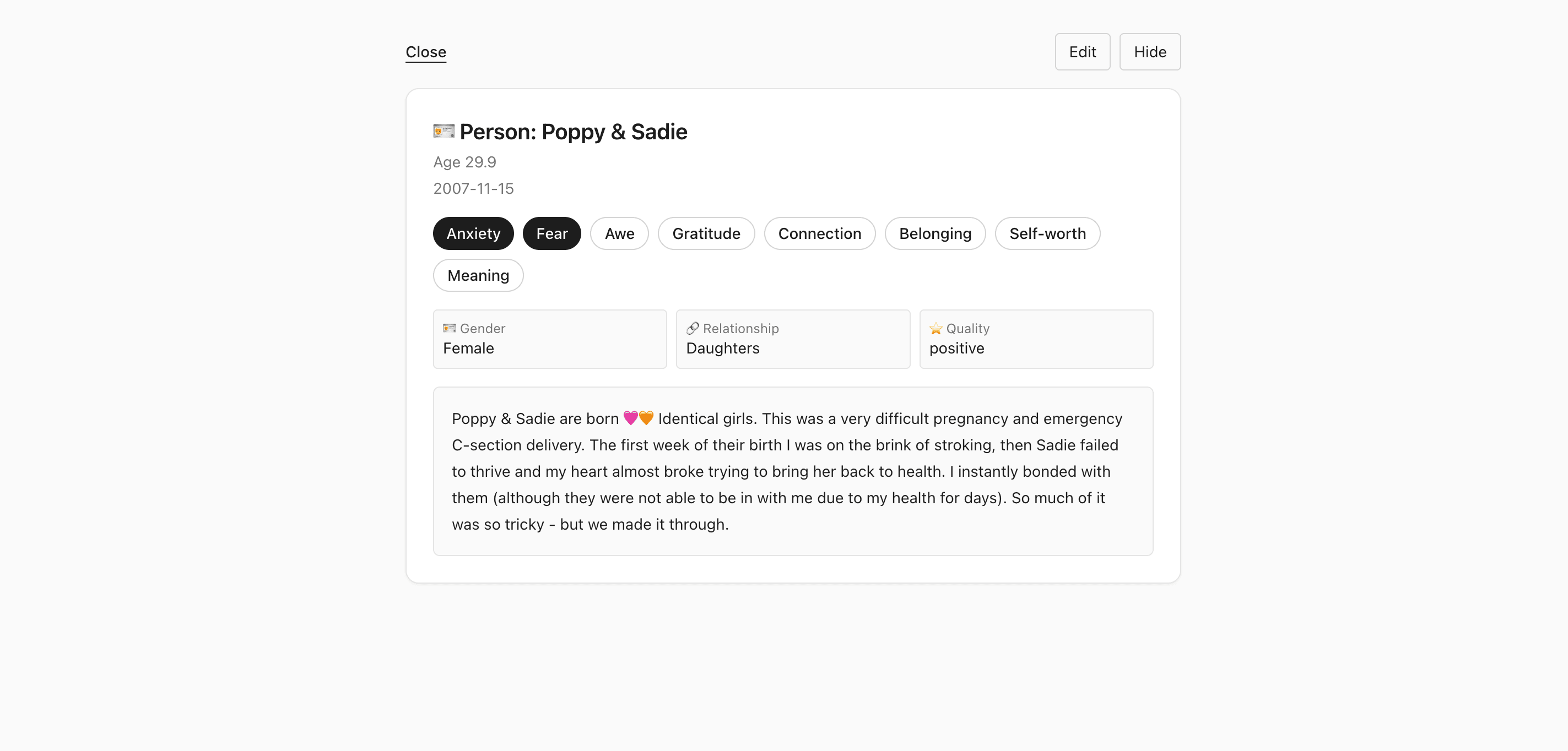
Product concept
Recount is built around two primary user groups.
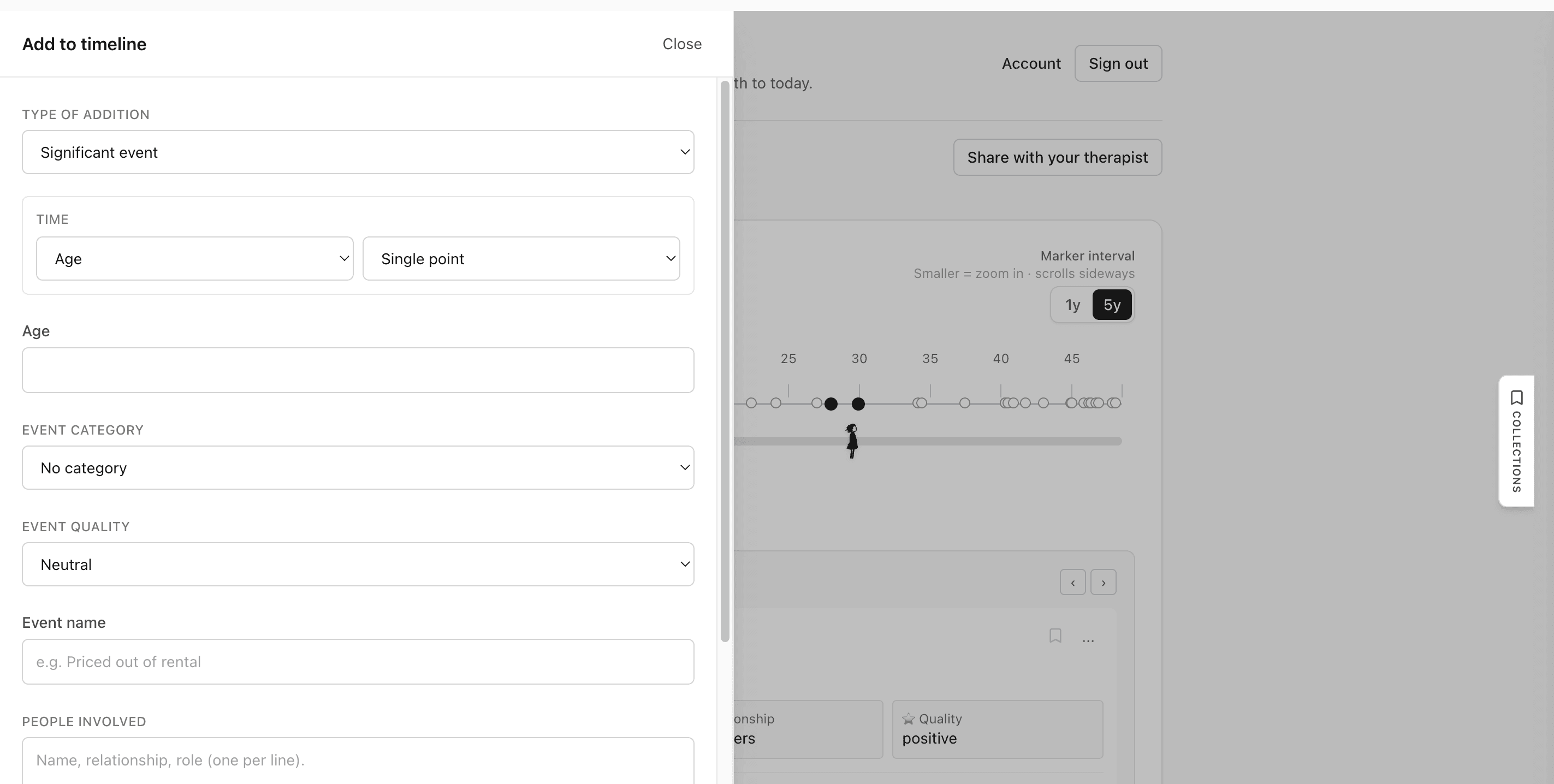
Authors are individuals creating and managing their own life timeline. They can add events, relationships and influences; record emotions connected to those experiences; create collections of important moments; add notes in their own words; and choose what they want to share.
Therapists are health professionals who are granted access to an Author’s timeline. Depending on permissions, they can review shared events, understand emotional context, create collections, add notes and use the timeline as a foundation for more informed therapeutic conversations.
The product is intentionally Author-led. Authors control their data, manage access, revoke access and decide how much context they want to share. This was a central design principle from the beginning: Recount needed to support vulnerable users without taking control away from them.
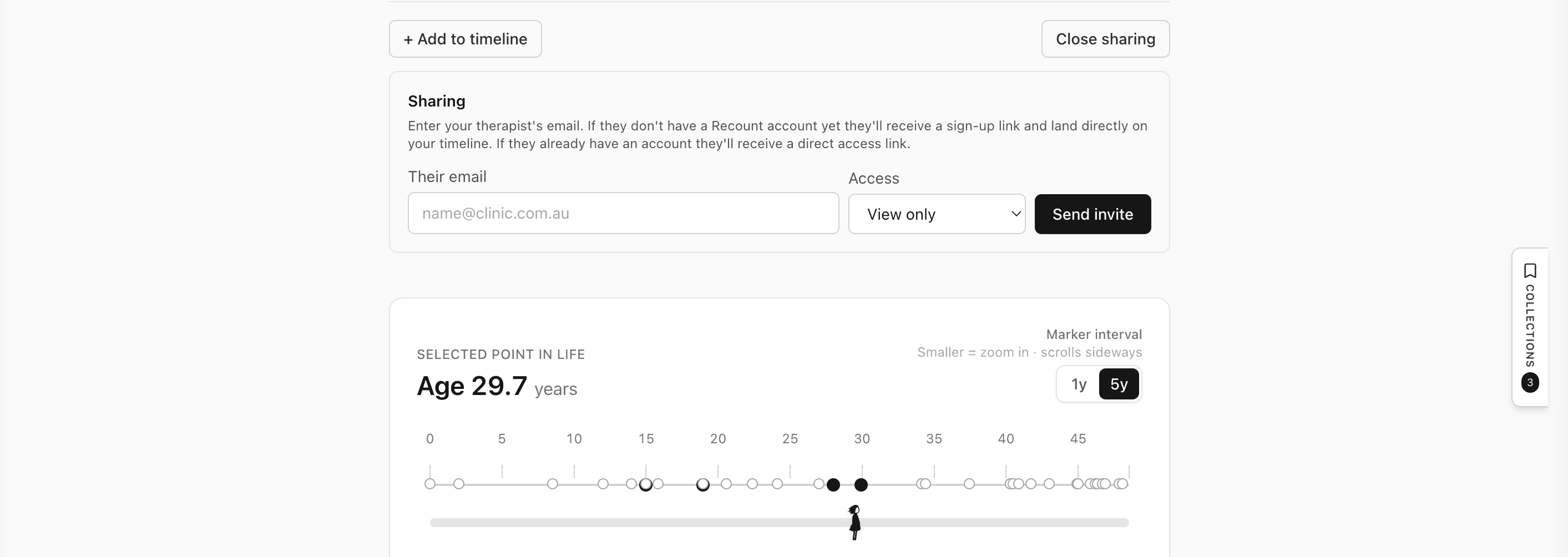
My role
I led the product from end to end, including:
- defining the product problem
- identifying the user groups
- mapping the Author and Therapist journeys
- designing the system logic and permission model
- shaping the information architecture and feature set
- designing the interface and interaction patterns
- building the application in Next.js
- implementing authentication, data structures and role-based access through Supabase
- managing version control through GitHub
- deploying the product through Vercel
- testing user flows across desktop and mobile contexts
- gathering feedback from Authors and psychologists after deployment
- iterating the product to better support existing therapist workflows
A key part of this project was learning how to work effectively with AI coding tools while retaining ownership of the product architecture and decision-making. Recount demonstrates that my value is not simply in using AI to generate code. My value is in knowing what needs to be built, why it needs to work that way, and how to direct AI tools toward a coherent product outcome.
How I used Cursor as an AI development tool
Cursor was used to accelerate the implementation phase of the project.
Once I had defined the user groups, user journeys, feature requirements and system logic, I used Cursor to help move faster through development tasks. This included generating and refining code, troubleshooting implementation issues, exploring approaches to component structure, improving form handling, working through Supabase queries, debugging permission logic and iterating interface states.
The project required a clear understanding of what I wanted the system to do before AI could be useful. For example, the distinction between Authors and Therapists, the access-sharing model, the ability to revoke access, the creation of collections and the emotional mapping of timeline events all required product and systems thinking before they could be translated into code.
This is where I believe my core strength sits. AI tools can dramatically accelerate development, but they are most powerful when directed by someone who can identify users, map journeys, structure product logic and make decisions about how a system should behave. Recount gave me a practical way to apply that strength: using AI to reduce development friction while relying on my own judgement to shape the product.
As feedback came in from real users and psychologists, Cursor also helped accelerate iteration. I was able to respond to product learnings quickly, test refinements, improve user flows and continue shaping the platform around how Authors and Therapists actually engage with it in practice.
Features delivered
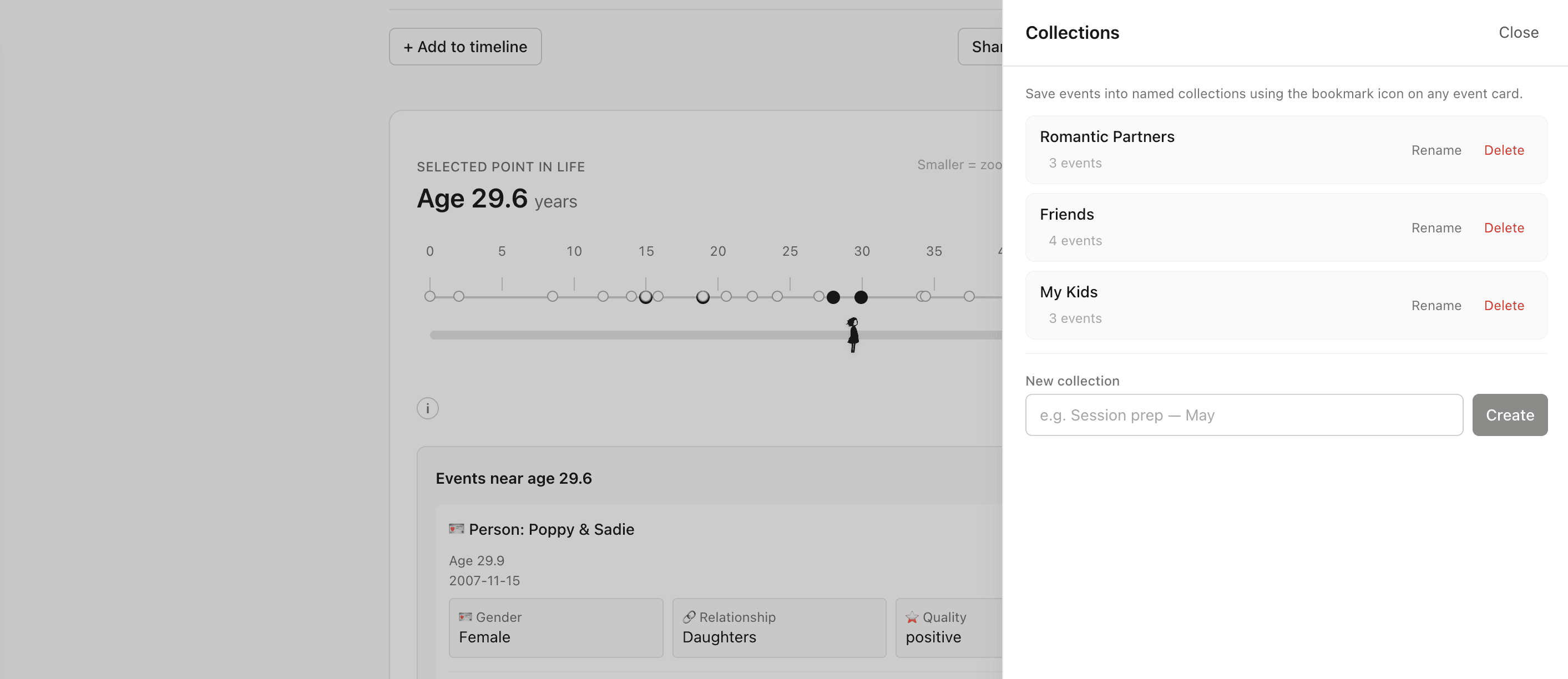
The launched product includes a range of Author-focused features, including avatar selection, timeline creation, event editing, emotional mapping, personal notes, bookmarked collections, secure sharing with therapists, access revocation and account deletion.
For Therapists, Recount supports account creation, accepting or declining access to an Author’s timeline, viewing shared events at different levels of detail, creating collections, adding notes, removing their own access and creating Author accounts on behalf of clients where appropriate.
These features required more than a static prototype. They required a working system with distinct user roles, sensitive information flows, secure access management and a responsive interface suitable for real-world use.
Technical approach
Recount was built as a Next.js project, with Supabase used for authentication, database management and user data. GitHub was used for version control, and Vercel was used to deploy the application.
This stack allowed me to work quickly while still building toward a real, usable product. Cursor supported the build process by helping me move through technical blockers faster, but the architecture, feature prioritisation and product decisions were driven by the needs of the Recount user experience.
From launch to user feedback
Since deployment, I have placed Recount in the hands of multiple Author and Therapist user groups. This has allowed me to validate the product beyond the build stage and understand how it performs in real-world therapeutic contexts.
Feedback from Authors and psychologists has been overwhelmingly positive. Author users have responded strongly to the ability to map their experiences at their own pace, while psychologists have recognised the potential value of receiving structured context before or during therapeutic work.
A key area of ongoing focus has been workflow integration for therapists. Rather than expecting clinicians to change how they work around the product, I have been refining Recount so it can support existing therapeutic processes. This has meant thinking carefully about how therapists access information, how much detail they need at different points, how collections can support clinical insight, and how the product can add value without creating unnecessary friction.
What this project demonstrates
Recount demonstrates my ability to use generative AI coding tools to accelerate the delivery of digital products without outsourcing the thinking that makes those products effective.
The project required me to operate across strategy, design, development, deployment and iteration. I translated a sensitive real-world problem into a functioning product, designed around user control, privacy and secure sharing. I used Cursor to accelerate implementation, but the product direction, feature prioritisation, user experience and system logic were guided by my own judgement.
For employers, Recount is an example of how I can bring together product thinking, systems knowledge and AI-assisted development to move quickly from concept to launch, then continue improving the product based on real user feedback. It shows that I can identify a problem, define users, map journeys, structure a solution, build the product, troubleshoot the implementation, deploy a live digital experience and iterate it with real-world use in mind.
In a workplace context, this is the value I bring to AI-enabled delivery: not just the ability to use new tools, but the ability to direct them with clarity. Recount shows how strong planning, user understanding and systems thinking can turn generative AI from a coding assistant into a genuine delivery accelerator.